Quick answer: Fall is a workable season for slabs and foundations in Columbia, Spring Hill, Franklin, and the rest of Middle Tennessee, but it takes more planning than a spring pour. Three things set the schedule: how wet the clay is, how cold the nights get in the first two days after the pour, and how soon the first freeze shows up. The NOAA outlook for October through December 2026 leans wetter and warmer than normal for our part of the state, so soggy ground may slow a slab job as much as cold weather does.
Why Fall Slab Work Is Different From a Driveway
A slab foundation, garage floor, or shop pad carries a building. It is usually thicker than a driveway, it sits on a base that has to stay stable for decades, and it often has footings dug into the soil around the edges. Each of those pieces reacts to water and cold in its own way.
There is some good news in that thickness. Thicker concrete holds its own heat longer, and the National Ready Mixed Concrete Association reflects that in its cold weather concreting guide. NRMCA recommends a minimum concrete temperature at placement of 55°F for sections less than 12 inches thick and 50°F for sections 12 to 36 inches thick. The ready mix plant can supply concrete at the temperature the job calls for.
The Fall 2026 Outlook for Middle Tennessee
The Climate Prediction Center seasonal outlook for October, November and December 2026, issued September 17, favors above-normal precipitation for much of the Mississippi and Tennessee Valleys. It also favors above-normal temperatures for nearly all areas east of the Mississippi River. CPC reports that El Niño conditions are present and gives a greater than 90 percent chance of a very strong event this fall and winter.
For October by itself, CPC shows equal chances for rain in Middle Tennessee, so the wetter lean applies to the three-month season rather than to October specifically. For a slab job, that points to planning around wet stretches later in the fall and keeping dates flexible.
Seasonal normals point the same way. According to NWS Nashville climate records, the normal low at Nashville drops from 49.9°F in October to 39.2°F in November, while normal precipitation rises from 3.36 inches in October to 3.86 inches in November.
Wet Clay Is the First Problem
Much of Maury and Williamson County sits on clay that swells when it is wet and shrinks when it dries. A slab poured on soaked, soft subgrade can settle unevenly once the ground dries out next summer. That is why the base matters more than the calendar on a fall job. Our guide to new construction foundations in Franklin goes deeper on how local soil shapes a foundation.
Before we pour a slab in the fall, we:
- Check the subgrade after every rain. If it ruts or pumps under equipment, we wait or rework it.
- Compact a gravel base and lay a vapor barrier. We never pour directly on dirt.
- Pump standing water out of footing trenches and dig out soft soil before any concrete goes in.
- Plan grading so water drains away from the slab, this winter and every winter after.
Cold Nights and the First Freeze
The NWS Nashville freeze and frost probability table shows a 50 percent chance of the first 32°F night by October 19 at the Columbia station and a 90 percent chance by November 2. Franklin reaches its 50 percent mark by October 18. A harder freeze of 28°F reaches the 50 percent mark around November 6 in Columbia.
The American Concrete Institute cold weather guide, ACI 306R, defines cold weather as any time the air temperature has fallen to, or is expected to fall below, 40°F during the protection period. In a Middle Tennessee fall, plenty of slab pours after mid-October will meet that definition for at least a night or two.
The ground cannot be frozen
NRMCA says snow and ice must be removed and the surfaces that touch fresh concrete must be above freezing before placement. That can mean insulating or even heating the subgrade ahead of the pour. Most October pours here will not need it, but it belongs in the plan for any late-season slab.
Protect the slab for the first two days
Fresh concrete freezes if its temperature falls below about 25°F, and NRMCA says early freezing can cut its potential strength by more than 50 percent. NRMCA recommends protecting concrete from freezing until it reaches 500 psi, about two days after placement. ACI notes that most well-proportioned mixes reach that strength within about 48 hours at 50°F.
Watch the temperature swing
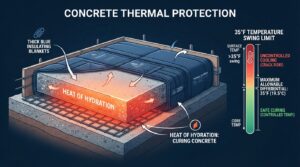
Thick slabs and footings build heat inside as the cement reacts. NRMCA warns that thermal cracking may occur when the difference between the surface and the interior goes beyond about 35°F. That is why insulating blankets come off gradually instead of all at once on a cold morning.
How Cool Weather Changes Curing and Form Removal
NRMCA gives a rule of thumb: a 20°F drop in concrete temperature roughly doubles the setting time. Cooler concrete also gains strength more slowly, so every step after the pour moves at a slower pace.
- Curing method: NRMCA does not recommend water curing when freezing temperatures are close. Membrane curing compounds or plastic sheets are the better choice for fall slabs.
- Form removal: NRMCA says forms should stay in place anywhere from 1 to 7 days, depending on strength gain, the weather, and the loads the concrete will carry.
- Loading the slab: Before stripping forms or putting loads on the slab, NRMCA recommends field-cured test cylinders or nondestructive testing to estimate the strength in place.
Framing crews and equipment operators often want on the slab right away. In cool weather, the answer should come from strength, not the date on the calendar.
There is an upside. ACI notes that concrete placed in cold weather, protected against freezing and properly cured, can develop higher ultimate strength and greater durability than concrete placed at higher temperatures, and it is less prone to thermal cracking. A careful fall pour can make a very good slab.
A Fall Slab Checklist for Homeowners and Builders
- Book the site visit and estimate early so the pour date can move with the weather.
- Ask how the crew will handle a cold night in the first 48 hours.
- Ask which curing method will be used and how long covers stay on.
- Get the base, vapor barrier, and reinforcement plan in writing.
- Agree on when framing or equipment can go on the slab, based on strength.
- Keep downspouts and runoff away from the new slab.
- Leave room in the schedule for rain days.
For the full sequence from layout to finishing, and the factors that drive price, see our post on concrete slab foundation installation steps and cost.
When to Push the Pour to Spring
If the site will not dry out, or the forecast shows a hard freeze inside the protection window and there is no practical way to cover and warm the slab, waiting is the smart call. For an addition or a new home, the builder’s schedule matters too, and we will walk through the tradeoffs with you. A slab poured on a firm, dry base in spring beats a rushed slab on wet clay in December.
Slab and Foundation Work Near You
We pour slabs and foundations from our home base in Columbia across Maury and Williamson counties. Learn more about concrete slab installation in Columbia, slab installation in Spring Hill, and our concrete foundation services. If you are comparing foundation types, our Columbia foundation contractor guide covers slab on grade versus crawl space. You can also browse all of our concrete services.
Frequently Asked Questions
Can you pour a concrete slab in the fall in Tennessee?
Yes. Fall pours are common in Middle Tennessee. The keys are a firm, dry base, a plan for any night that drops toward freezing in the first two days, and a curing method suited to cool weather.
How cold is too cold to pour a slab foundation?
ACI treats any time the air falls, or is expected to fall, below 40°F during the protection period as cold weather. That calls for protection, not an automatic stop. NRMCA notes that fresh concrete freezes below about 25°F, so the slab must be kept warmer than that until it gains strength.
How long should a new slab be protected from freezing?
NRMCA recommends protection until the concrete reaches 500 psi, about two days after placement. ACI says most well-proportioned mixes reach that strength within about 48 hours at 50°F. Colder conditions stretch that time.
Can concrete be poured on wet or frozen ground?
Not frozen ground. NRMCA says surfaces in contact with fresh concrete must be above freezing and free of snow and ice. Wet clay is a judgment call. If the subgrade is soft or pumping, it needs to dry or be reworked and compacted first.
Will a wet fall delay my foundation?
It might. The CPC outlook for October through December 2026 favors above-normal precipitation for much of the Tennessee Valley. Build some rain days into the schedule and book early so there is room to move the pour.
How soon can framing start on a slab poured in cool weather?
It depends on strength, not a set number of days. NRMCA recommends field-cured cylinders or nondestructive testing to estimate strength in place before loading a slab or stripping forms, and cool weather slows strength gain.
Is a slab poured in cold weather weaker?
Not if it is protected and cured properly. ACI notes that concrete placed in cold weather, kept from freezing and cured long enough, can reach higher ultimate strength and greater durability than concrete placed in hot weather.
Plan Your Fall Slab With a Local Crew
If you have a slab, shop pad, or foundation on the calendar this fall, let us help you plan around the weather. Call AMC Concrete at (931) 416-5131 or reach us through our contact page. We will look at your site, talk through timing, and give you a clear, written plan for the pour.