What is a concrete slab, and which type does your project need? A concrete slab is a flat, horizontal surface made of poured concrete, usually reinforced with steel rebar or wire mesh. It forms the base for homes, garages, patios, driveways, warehouses, and many other structures. At AMC Concrete, we pour slabs across Middle Tennessee, and our team handles concrete slab installation in Columbia, TN from site prep to final finish.
This guide explains how slabs work, the main types, what drives the price, and how a slab is installed.
Concrete Slab Basics
So, what is a concrete slab made of? It is a mix of cement, water, sand, and aggregate such as gravel or crushed stone. The mix is poured into formwork, leveled, and left to cure into a solid, stable surface. Slabs can be built in different thicknesses, finishes, and designs, depending on the load they must carry.
Homeowners often ask, “What is a concrete slab, and how is it different from a pad or a footing?” A pad is usually a smaller, thinner slab for items like an AC unit or a shed. A footing is the thicker section under a wall that carries its weight. A slab is the large, flat surface itself.
What is a concrete slab good for? These are its main advantages:
- Durability: Handles heavy loads, weather, and daily wear
- Low maintenance: Needs little more than cleaning and occasional sealing
- Versatility: Works for residential, commercial, and industrial projects
- Fire resistance: Concrete does not burn
- Pest resistance: Termites cannot damage it the way they damage wood
- Long-term value: A long lifespan keeps repair costs low
Types of Concrete Slabs
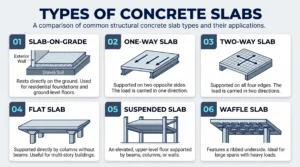
For most homeowners, slab-on-grade is the type that matters. It is poured directly on prepared ground and used for garages, patios, driveways, and many house foundations. The other types below are mostly used in larger commercial and multi-story buildings.
| Slab Type | How It Works | Common Uses |
|---|---|---|
| Slab-on-grade | Poured directly on compacted, prepared ground | House foundations, garages, patios, driveways, sidewalks |
| One-way slab | Carries load in one direction, supported on two opposite sides | Residential floors, small offices |
| Two-way slab | Carries load in both directions with steel running both ways | Warehouses, large commercial floors |
| Flat slab | A two-way slab with no beams, supported directly by columns | Office buildings, apartment complexes |
| Suspended slab | Elevated slab that does not rest on the ground | Multi-story buildings, parking structures |
| Waffle slab | Grid of ribs underneath reduces weight and keeps strength | Large halls, long-span industrial floors |
Choosing the right type depends on load, span, soil, budget, and design needs. If you need a driveway or outdoor living space, see our concrete driveway replacement in Columbia, TN and stamped concrete patio options.
Concrete Slab Design Considerations
A durable slab starts with planning. These are the key factors:
- Thickness: Many residential slabs are around 4 inches thick, but load and local code decide the final number
- Reinforcement: Rebar, wire mesh, or fiber reinforcement
- Soil and site preparation: Proper compaction prevents settling and cracking
- Moisture control: A vapor barrier protects the slab from ground moisture
- Finish: Smooth, broom, stamped, or polished surfaces
Slabs for houses must meet the residential code enforced by your local building department. Tennessee adopts the International Residential Code through the Tennessee State Fire Marshal’s Office, so confirm what applies to your address. For deeper technical guidance on slab and soil design, the American Concrete Institute publishes training material on slabs on ground.
How a Concrete Slab Is Installed
- Site preparation: The area is cleared, leveled, and compacted, with drainage planned so water never pools under the slab.
- Formwork and reinforcement: Forms set the shape and thickness, and rebar, mesh, or fibers are placed.
- Pouring: Concrete is poured evenly with the correct mix for the job.
- Leveling and finishing: Screeds and trowels level the surface, then the chosen finish is applied.
- Curing: The slab is kept moist for several days. What is a concrete slab without proper curing? A weaker surface that is far more likely to crack.
DIY pours can look cheaper at first, but poor prep or reinforcement often leads to expensive repairs later. A professional crew gets the thickness, level, and reinforcement right the first time.
What Does a Concrete Slab Cost?
Slab cost depends on size, thickness, type, reinforcement, site conditions, and finish. A slab usually costs more upfront than some alternatives, but its long lifespan and low maintenance make it a cost-effective investment. For numbers, read our guide on how much a concrete slab costs in 2026. To estimate how much concrete you need, use our concrete calculator.
Concrete Slab Maintenance
- Clean regularly: Sweep or pressure wash to remove debris
- Seal periodically: Sealer protects against water, chemicals, and stains
- Repair small cracks early: Fill them before water gets in
- Respect load limits: Do not overload a slab beyond its design
- Manage drainage: Keep water from pooling around the edges
Frequently Asked Questions
How thick should a concrete slab be?
Many residential slabs are around 4 inches thick, but the right thickness depends on the load, soil, and local code. Driveways and garage floors that carry vehicles often need more, so confirm with your contractor.
Does a concrete slab need rebar or wire mesh?
Most slabs benefit from reinforcement like rebar, wire mesh, or fibers. It helps control cracking and carry loads, and the right choice depends on the slab’s use, thickness, and soil conditions at your site.
How long does a concrete slab take to cure?
Concrete usually hardens enough for light foot traffic in a day or two, but full strength takes about 28 days. Keep heavy vehicles off the slab until your contractor says it is ready. Weather affects curing time.
Is a concrete slab the same as a foundation?
Not always. A slab can be the foundation itself, as in slab-on-grade homes, or it can be a standalone surface like a patio or driveway. Foundations can also be crawl spaces or basements. Your builder picks what fits the lot.
Do concrete slabs crack?
Most slabs develop some minor cracks as concrete shrinks while curing. Proper base prep, reinforcement, control joints, and curing keep cracks small and controlled, and AMC Concrete can inspect any crack that worries you.
Final Thoughts
So, what is a concrete slab at its core? It is the foundation of safety, durability, and long-term performance for any structure, from a backyard patio to a full house. The right slab type, solid prep, and careful curing decide whether it lasts for decades or cracks in a few years.
If you are planning a slab, driveway, or patio, AMC Concrete is ready to help. We serve Columbia, Spring Hill, and communities across Middle Tennessee. Get your free estimate today or call us at 931-416-5131.