Can you pour concrete in cold weather? Yes, but only when the mix, the site, and the protection plan are all set up for it. Concrete does not simply stop working when the temperature drops. It sets more slowly, gains strength more slowly, and can be badly damaged if it freezes before it hardens. At AMC Concrete, we pour driveways, patios, and concrete slab installation in Columbia, TN projects across Middle Tennessee, and this guide explains the temperatures that matter, the steps that protect your pour, and the signs that a job should wait.
Timing questions usually start in fall, which is why we wrote about pouring a concrete driveway in October and the first freeze. This article goes further. It covers what counts as cold weather, how mix temperature and curing change, and how to decide between pouring now or waiting for spring.
Can You Pour Concrete in Cold Weather in Middle Tennessee?
Our winters are mild compared with the Midwest, but they are not warm. NWS Nashville records show about 67 days a year with a low at or below 32 degrees, including 19 days in January. Frost date charts put the average first and last freeze dates for Nashville near October 31 and April 1, so freezing nights can show up across a window of about five months. Daytime highs often climb well above freezing, and that fools people into thinking a pour is safe. The real danger is the night after the pour, when fresh concrete is still soft and holding water.
What Counts as Cold Weather for Concrete
Cold weather has a technical meaning. Under the ACI definition of cold weather concreting, set in ACI 306R-16, cold weather exists when the air temperature has fallen to, or is expected to fall below, 40 degrees Fahrenheit during the protection period. The protection period is the time concrete needs shelter to gain strength. That trigger is higher than most homeowners expect, because a pour on a 45 degree afternoon can count as cold weather if the forecast drops below 40 that night. The newer ACI definition also triggers cold weather procedures more often than older editions did, and NRMCA uses a slightly different rule based on average daily temperature, so ask your contractor which standard they follow. So when someone asks can you pour concrete in cold weather, the better question is how much protection the forecast calls for.
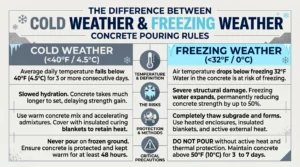
The Difference Between Cold Weather and Freezing Weather
These two terms get mixed up all the time, but they call for different responses. The table below shows how they compare.
| Factor | Cold Weather | Freezing Weather |
| Air temperature | At or expected below 40 degrees during protection | At or below 32 degrees |
| Main concern | Slower setting and slower strength gain | Water in fresh concrete turning to ice |
| Typical response | Warmer mix, covers, and temperature checks | Heated enclosures, insulation, or a delayed pour |
| Risk if ignored | Weak early strength and a rough finish | Lasting strength loss, scaling, and cracking |
| Can you pour | Yes, with a plan | Only with strong protection in place |
Key Points to Remember
The short answer to can you pour concrete in cold weather is yes, with planning. Keep these points in mind before you schedule a job.
- Cold weather starts near 40 degrees, not freezing.
- Cold slows setting, so finishing takes longer.
- Fresh concrete must never freeze before it gains strength.
- The ground, forms, and base should be free of ice and above freezing.
- Protection after the pour matters as much as the mix.
- A contractor who cannot explain a cold weather plan is a warning sign.
Mix and Temperature Rules
Concrete has to be warm enough when it is placed and stay warm while it gains strength. The cold weather concrete mix and temperature rules discussed in Structure magazine call for checking concrete temperature at the plant, again at the point of placement, and again during the protection period. Heating and tenting the pour area is one way to hold temperature. Accelerating admixtures can speed up setting when they are dosed to the air temperature, and freeze resistant concrete uses an accelerator that allows a lower temperature at placement.
Your ready mix supplier controls most of this, so ask these questions before the truck is scheduled.
- What temperature is the concrete targeted to arrive at?
- Will the mix include heated water or an accelerator?
- How will temperature be checked at the site?
- Who decides if the pour should be delayed?
We never add water at the jobsite to make concrete easier to work, because extra water weakens the finished slab.
Fall and Early Winter Pours
Many Tennessee pours happen in the shoulder season, when days feel mild but nights drop quickly. Our post on pouring a concrete slab in fall explains wet clay, cold nights, and cure time in more detail, and the same rules apply to driveways and patios. A few habits help any late season pour.
- Check the five day forecast, not just tomorrow.
- Skip ground that is frozen, snow covered, or soaked.
- Schedule the pour early in the day so finishing is done before dark.
- Allow extra time for finishing, since cold slows the surface.
- Have covers ready before the concrete arrives.
Protection and Curing
Protection is where cold pours succeed or fail. NRMCA explains in its cold weather concreting guide that fresh concrete can freeze when its temperature falls below about 25 degrees, and that frozen concrete can lose more than half of its potential strength. A trade article on how to protect concrete during cold weather pours lists three goals. Prevent early age freezing, keep the temperature up long enough for strength gain, and avoid thermal shock when protection comes off. It also advises protecting corners and edges first, since those freeze fastest, and notes that extra heat adds cost.
In practice, that means insulated blankets over the slab, windbreaks on exposed sides, and covers that stay on until the concrete is ready. Remove protection gradually rather than all at once on a cold morning, and keep deicing salt off new concrete during its first winter.
The Risk of Cracks After the Pour
Concrete that froze while young can look fine for weeks. The damage often appears later as scaling, surface flaking, and cracking. If you are dealing with older concrete, our guide on cracks that show up after winter explains how to tell a cosmetic crack from a serious one. For new pours, the best defense is protecting the slab during the first days, when it is most vulnerable.
How Cold Weather Affects Different Projects
Not every project reacts the same way. Here is what changes by project type.
- Driveways. These carry heavy loads, so strength matters before vehicles go on. If your old driveway is failing, see our page on concrete driveway replacement in Columbia, TN.
- Sidewalks. Thin sections lose heat quickly, so they need prompt covering and no deicers early on.
- Colored concrete. Uneven curing can cause color differences, so consistent protection matters.
- Stamped concrete. Cold slows setting, which shifts the timing window for stamping and finishing.
- Slabs and foundations. Larger areas need more covering and careful base preparation.
How We Handle Cold Weather Pours
When customers ask can you pour concrete in cold weather, we start with the forecast. We talk with the ready mix plant about mix temperature, confirm the base is firm and free of ice, and keep covers on site before the pour begins. If protection is not practical, we reschedule instead of gambling with your slab. You can see the results in our completed concrete projects, which include work poured across all four seasons in Middle Tennessee.
When to Wait Until Spring
Sometimes waiting is the smartest call. Consider delaying your pour in these cases.
- The ground is frozen or buried under snow and ice.
- The forecast shows a hard freeze with no practical way to cover the slab.
- The project needs a delicate finish, such as stamped or colored work.
- Crews cannot guarantee covers will go on right after finishing.
A slab poured on a firm base in mild spring weather beats a rushed pour in a deep freeze.
Frequently Asked Questions
Q: What is the lowest temperature you can pour concrete?
A: There is no single cutoff. Air near or below 40 degrees calls for cold weather steps, and fresh concrete freezes below about 25 degrees. Warm mix, insulated covers, and temperature checks make cold pours possible.
Q: Is it better to pour concrete in winter or wait for spring?
A: Spring is easier, but winter pours work with planning. Wait if the ground is frozen, nights will drop hard, or covers cannot go on right away. Rushing a pour risks damage that costs much more to fix later.
Q: How long should new concrete be protected from cold?
A: Protect it until it has enough strength to survive freezing, which depends on the mix and the weather. Colder air stretches that time. Your contractor should track temperatures and keep covers on until the slab is ready.
Q: Does cold weather make a concrete pour cost more?
A: It can. Heated enclosures, insulated blankets, special mixes, and extra monitoring add cost, and weather delays can add schedule time. Ask for written quotes that list exactly what protection is included.
Q: Can you pour stamped or colored concrete in cold weather?
A: Yes, but it is harder. Cold slows setting, so stamping and finishing take longer, and uneven curing can cause color differences. Waiting for milder days often protects the finish. Ask your contractor about timing.
Final Thoughts
Can you pour concrete in cold weather? Yes, when the mix is warm, the base is firm, and the slab is protected until it gains strength. Learn the 40 degree trigger, ask your contractor how they will handle cold nights, and be willing to wait when the forecast turns against you.
AMC Concrete is a veteran owned contractor in Columbia, TN, licensed under Tennessee contractor license 82796. When you want a clear plan for your pour, get a free inspection or call us at 931-416-5131.