Quick answer: A lasting concrete patio in Columbia, Franklin, Spring Hill and the rest of Middle Tennessee depends on the base, the slope, the joints and the cure, not just the finish you see on pour day. We excavate and compact a gravel base, set forms for water to drain away from the house, pour a durable ready mix with Fibermix fiber reinforcement, cut or tool control joints on schedule, and protect the slab while it cures. Decorative choices such as broom, stamped or colored finishes come after those structural steps are planned.
Why Patio Installation Is Different Here
Middle Tennessee soil puts real pressure on outdoor slabs. Clay expands when it is wet and shrinks when it dries. Disturbed fill around newer homes can keep settling for years. A patio poured on soft or uneven ground will crack or sink long before the finish wears out.
Rain and shade matter too. Patio space often sits close to the house, under trees, or beside a pool. Water that pools against a foundation or under furniture shortens the life of the slab. NWS Nashville climate records show humid summers and cool fall nights across the region, so drainage and curing plans have to match the season you pour.
If you want the service page first, see our concrete patio installation page for layout and finish options. This guide focuses on how installation actually works on the ground across Columbia and nearby towns.
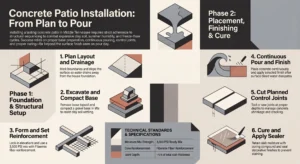
Step 1: Plan the Layout and Drainage
Start with how you will use the space. A dining patio near the kitchen door needs a different size and traffic path than a fire pit pad at the back of the yard. Mark doors, steps, utilities and trees before anyone digs.
- Slope the surface so water runs away from the house, not toward it.
- Keep patio edges clear of downspouts that dump water under the slab.
- Leave room for isolation joints where the patio meets the house, steps or an existing driveway.
- Decide early whether you want a broom finish, stamped pattern or color, because those choices change timing on pour day.
Isolation joints are full depth separators that let the patio move without fighting the foundation or a sidewalk. The National Ready Mixed Concrete Association covers them in its guide to joints in slabs on grade.
Step 2: Excavate and Build a Compacted Base
We remove sod and soft topsoil, then bring the area to the right elevation. On clay sites we dig deeper when soft spots show up under the excavator. A compacted gravel base gives the slab something firm to sit on and helps water move under the patio instead of sitting in voids.
We never pour patio concrete on loose dirt or uncompacted fill. That shortcut is a common reason new patios settle in Maury County and Williamson County. Compaction happens in lifts so the base density is even across the whole pad.
For decorative projects that need a custom look, many homeowners pair this base work with premium stamped concrete so the finish and the structure are planned as one job.
Step 3: Forms, Thickness and Reinforcement
Forms lock in the shape, the elevation and the slope. Patio thickness is set for foot traffic and outdoor furniture, and thicker sections are used where a grill island, hot tub pad or vehicle access is planned. Reinforcement is placed so it sits in the slab, not on the dirt. Every AMC pour uses a 3,500 PSI minimum mix with Fibermix fiber reinforcement in every yard. Structural sections also receive rebar where the job calls for it. Reinforcement helps keep cracks tight if the slab moves. It does not stop every crack.
The Tennessee Concrete Association points homeowners and builders to ACI 332 for residential exterior concrete standards in its driveways guidance for Tennessee. That guidance covers outdoor exposure details such as curing and freeze thaw resistance. The same placement discipline that protects driveways also protects patios that see rain, cold nights and deicers near entries.
Step 4: Mix, Place and Finish
We order ready mix for the day, check the weather, and place concrete in a continuous pour so cold joints do not show up in the middle of the patio. In cold climate regions, industry practice often calls for air entrainment so water inside the concrete has room to expand when it freezes. Ask any contractor how their exterior mix is specified for Middle Tennessee winters, and confirm the strength and fiber package you are buying.
Finishing follows the bleed water, not the clock. NRMCA finishing guidance for flatwork warns against working the surface while water is still rising. Premature finishing can leave a weak top layer that dusts or scales later. For exterior patios we typically broom the surface for traction, or move into stamping and coloring when that is the plan.
Common patio finishes
- Broom finish: simple, slip resistant and easy to maintain.
- Stamped concrete: patterns that look like stone, brick or wood when colored and sealed.
- Colored concrete: integral color or surface color for a uniform tone.
- Exposed aggregate: a textured look that hides minor wear well.
Homeowners in Franklin can review local service options on our concrete services in Franklin page before choosing a finish. Brentwood projects are covered on concrete services in Brentwood, and Spring Hill work is outlined on our concrete service in Spring Hill page.
Step 5: Joints That Control Cracking
Concrete shrinks as it dries and changes size with temperature. Cracks will form somewhere. Joints are planned cracks that keep the pattern neat and easier to maintain. NRMCA CIP 6 recommends contraction joints spaced about 24 to 36 times the slab thickness, with panels kept close to square and joint depth about one quarter of the slab thickness.
NRMCA CIP 4 on cracking also stresses curing and subgrade support. Joints alone cannot save a patio poured on soft clay or left to dry out in hot sun. We tool or saw joints on the slab schedule so the cut is deep enough and early enough.
Step 6: Cure, Seal and First Season Care
Curing keeps moisture in the slab so the surface gains strength. We use curing compound or covers suited to the weather. Foot traffic usually waits until the surface is hard enough, and furniture placement follows our instructions for that pour.
Sealing is a maintenance step after the concrete has cured enough for the product you choose. Stamped and colored patios especially benefit from a quality sealer that protects color and reduces staining. Avoid harsh deicers near new concrete. Soft sand is safer for winter traction than rock salt on a young slab.
Local crews who install stamped patios in Columbia often walk homeowners through sealing schedules during the estimate. See our stamped concrete patio contractor in Columbia page if that is your town. Every new AMC installation includes a 3 year written workmanship warranty, and our team is licensed under contractor license number 82796.
What Homeowners Should Ask Before Hiring
- How will you prepare and compact the base on my soil?
- What slope will move water away from the house?
- Where will isolation joints and control joints go?
- What strength and fiber package will you pour, and how is the mix set up for outdoor exposure here?
- What is the cure plan, and when can we use the patio?
- Who handles sealing, and when should it be reapplied?
- What warranty and license cover the work?
Clear answers to those questions matter more than a pretty stamp photo. You can review outdoor options on our services page, then request a visit through contact us.
How Long Does Patio Installation Take?
Most residential patios take a few days of site work and pour time, then a curing window before heavy use. Size, access, demolition of old concrete, and weather all change the calendar. Cool weather slows set time. Hot, windy weather speeds surface drying and can raise the risk of plastic shrinkage cracks if the crew is not ready with curing measures.
We schedule around the forecast so the pour is not fighting a storm or a freeze. If rain is coming, we would rather move the date than trap water in a soft base.
Frequently Asked Questions
Q: How long does concrete patio installation take in Middle Tennessee?
A: Most patio jobs take several days for excavation, base work, forming and pouring, then additional cure time before furniture and heavy use. Exact timing depends on size, access, whether old concrete must be removed, and weather.
Q: Do I need a gravel base under a concrete patio?
A: Yes. A compacted gravel base supports the slab and helps drainage, especially on Middle Tennessee clay. Pouring on soft soil or uncompacted fill is a common cause of early settling and cracking.
Q: What finish is best for a patio that gets wet?
A: A broom finish gives good traction for everyday use. Stamped and colored finishes can also work outdoors when joints are planned, the mix is specified for exterior exposure, and a suitable sealer is maintained.
Q: How soon can I put furniture on a new patio?
A: Light foot traffic often comes first, then furniture after the crew confirms the slab has gained enough strength. Cool weather can extend that wait. Follow the schedule given for your pour instead of a generic rule from the internet.
Q: Will my patio crack?
A: Some cracking is normal as concrete shrinks. Proper joints, a stable base and curing reduce random cracks and keep movement controlled. Fibermix and rebar help hold cracks tight but do not eliminate them.
Q: Can stamped concrete be installed as part of patio installation?
A: Yes. Stamping is done while the concrete is still plastic, so pattern choice, color and timing must be decided before pour day. Ask to see local stamped patio examples during your estimate.
Q: How do I get a patio estimate from AMC Concrete?
A: Call (931) 416-5131 or use the contact form on our website. We review the site, discuss layout and finish options, and provide a clear written estimate before any work begins.
Q: Ready to Plan Your Patio?
A: A concrete patio is an outdoor room that has to handle clay soil, summer storms and winter nights. When the base, slope, joints and cure are done right, the finish you choose stays attractive for years. AMC Concrete installs patios across Middle Tennessee with that sequence in mind, using a 3,500 PSI minimum mix with Fibermix and a 3 year workmanship warranty.
Call Adam at (931) 416-5131 or reach us through contact us to schedule an on site visit. Tell us how you want to use the space, and we will map the installation steps to your yard.