Quick answer: Repair or level a concrete driveway when damage is limited, the slab is still sound, and the base can be stabilized. Plan a full replacement when the surface is crumbling across large areas, panels are broken into many pieces, thickness or reinforcement was never adequate, or drainage keeps failing. In Middle Tennessee clay country, the soil under the slab often decides the call as much as the cracks you see on top.
Why Driveways Fail Early Here
Clay soil in Maury County and Williamson County swells when wet and shrinks when dry. That movement opens voids under a slab, tips panels toward the garage, and turns small cracks into trip hazards. Add freeze thaw cycles and the wrong winter salt, and the surface can scale even when the base is fair.
NWS Nashville climate records show a long warm season and enough winter cold for outdoor concrete to see repeated wetting and freezing. The Tennessee Concrete Association notes that exterior residential concrete here should follow ACI 332 practices for severe freeze thaw exposure, including careful curing and mixes built for outdoor winters, in its driveways guidance for Tennessee.
If you already know you need a new pour, our concrete driveway installation page explains how we build from the base up. This article helps you decide whether that full rebuild is necessary yet.
Start With a Simple Inspection
Walk the driveway after a rain. Note where water sits, where edges have broken, and where one panel sits higher than the next. Press along cracks. A tight hairline crack that has not grown in a year is different from a crack you can fit a coin into.
- Surface only: light scaling, shallow popouts, or isolated hairline cracks.
- Structural movement: panels that rock, sunken corners, gaps at the garage apron, or wide cracks with vertical offset.
- Widespread failure: map cracking across many panels, exposed aggregate from deep scaling, or concrete that crumbles when you scrape it.
Our earlier post on warning signs your concrete needs repair lists common symptoms. Use this guide to match those symptoms to repair, leveling or replacement.
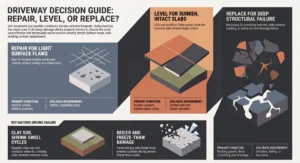
When Repair May Be Enough
Homeowners and industry guides often discuss localized options when most of the driveway still has a solid surface and a stable base. Crack sealing can slow water entry into joints and narrow cracks. Patching can restore a broken corner that is otherwise supported. Resurfacing can hide worn texture on a slab that is still level and sound underneath. Those approaches are tools to talk through on site, not a one size answer.
Repair is not a cure for active soil movement. If the same crack opens again after every wet season, the base or drainage still needs attention. NRMCA CIP 4 on cracking ties many surface cracks to subgrade support, joints and curing. Filling a crack without fixing those causes often means repeating the work.
For an assessment of what your driveway needs, start with our concrete repair contractors page and schedule a visit. We will tell you honestly whether a limited repair path makes sense or whether leveling or replacement is the better investment.
When Leveling Beats a Tear Out
Sunken slabs with otherwise intact concrete are leveling candidates. If a panel has dropped because soil washed out or settled, lifting and stabilizing can restore grade and drainage without demolishing the whole driveway. Homeowners in Franklin often ask about this path first. Our concrete leveling in Franklin page compares lift work with full replacement for that city.
Leveling works best when:
- The concrete is mostly in one piece, not shattered.
- The main problem is height and drainage, not a soft, scaled surface.
- You can still establish a path for water away from the house after the lift.
Leveling is the wrong tool when the slab is thin, poorly reinforced, or already broken into many fragments. Raising broken pieces does not create a new driveway.
When Full Replacement Is the Better Investment
Replacement costs more up front and takes longer, but it resets thickness, base, joints and drainage. Choose replacement when several of these are true:
- Cracks form a network across most panels.
- Scaling has eaten deep into the surface and keeps spreading.
- Panels rock or pump mud at the joints when a car passes.
- The driveway was poured thin, on dirt, or without control joints.
- Water drains toward the garage or foundation no matter how you patch.
- Prior patches failed within a season or two.
A new pour lets us excavate soft clay, compact a gravel base, place the right thickness, and cut joints on a proper layout. Every AMC pour uses a 3,500 PSI minimum mix with Fibermix fiber reinforcement in every yard, plus rebar on structural sections. Projects are backed by a 3 year written workmanship warranty, and we are licensed under contractor license number 82796. NRMCA CIP 6 explains how contraction and isolation joints control where cracks form. Skipping that layout on the old slab is often why random cracks keep returning.
For local context, review our concrete services in Franklin page, concrete services in Brentwood, and concrete service in Spring Hill. Columbia and nearby Maury County jobs follow the same base, mix and warranty standards.
Salt, Scaling and the Surface You Can Still Save
Not every ugly surface means the driveway is finished. Light scaling from deicers can sometimes be sealed and managed if the slab is still structurally sound. Deep scaling that exposes coarse aggregate across large areas usually points to replacement, especially if freeze thaw damage continues each winter.
NRMCA CIP 2 on scaling warns against aggressive deicers on concrete and notes that new concrete is especially vulnerable. The Tennessee Concrete Association likewise tells homeowners not to apply salt or deicers the first winter on a new driveway. If your current slab is only mid life, better winter habits and a penetrating sealer after any repair work can slow further surface loss.
A Decision Checklist You Can Use This Week
- Map every crack and sunken spot after rain.
- Check whether water flows toward or away from the house.
- Note any prior patches and whether they held.
- Ask whether the problem is surface wear, settlement, or both.
- Get an on site opinion before buying bags of patch mix for a moving slab.
Bring photos to the estimate if you want a first pass by phone, then confirm with a site visit. Soft spots under the slab often show up only when someone probes the joints or watches how panels move under a vehicle.
What a Quality Replacement Includes
If replacement wins, insist on a clear scope: removal and haul away, compacted base, forms and slope, concrete thickness, Fibermix and rebar where needed, joint layout, cure plan and first winter care. Industry guidance for exterior driveways in Tennessee stresses mixes and curing suited to freeze thaw weather. So does keeping cars off until the crew says the slab is ready.
Decorative upgrades such as a stamped entrance can be planned at this stage without changing the structural sequence. The finish is the last chapter, not a substitute for base work.
Repair Now or Wait Until Spring
Homeowners often ask whether a cracked driveway can wait for warmer weather. Small sealed cracks can wait if water is not collecting under the slab. Sunken panels that send water toward the garage should not wait, because wet seasons make soil loss worse.
Cool weather is still a workable window for many replacements as long as the pour is protected from freezing in the first days. Patch work on a wet, muddy base is a poor idea in any season. If the soil is soft, fix drainage and compaction first, then schedule the concrete.
A short on site visit usually settles the timeline. We would rather give you a clear repair versus replace call than sell a patch that fails after the next heavy rain.
Frequently Asked Questions
Q: Can a cracked concrete driveway be repaired instead of replaced?
A: Yes, when cracks are limited, the slab is still sound, and the base is stable. Wide cracks with vertical offset, rocking panels, or deep scaling across large areas usually call for leveling or full replacement instead of simple patching.
Q: What is the difference between concrete leveling and replacement?
A: Leveling lifts and stabilizes existing slabs that have settled but remain mostly intact. Replacement removes the old concrete and builds a new driveway with a new base, thickness and joint layout.
Q: Does Middle Tennessee clay make driveway problems worse?
A: Clay that swells and shrinks with moisture is a major reason slabs settle or heave here. Proper excavation, compaction and drainage matter as much as the concrete mix.
Q: When do homeowners consider concrete resurfacing?
A: Resurfacing is an industry option that can improve appearance on a driveway that is still level and structurally sound. It is a poor choice over moving panels, deep scaling or a failed base. An on site assessment decides whether resurfacing, leveling or replacement fits your slab.
Q: How do I know if drainage is part of the problem?
A: If water pools on the slab, runs toward the garage, or softens the soil at the edges after storms, drainage is involved. Repairing cracks alone will not fix water that keeps undermining the base.
Q: Should I use salt on a repaired or new driveway?
A: Avoid harsh deicers, especially on new concrete and during the first winter. Sand for traction is safer. Follow sealer and winter care advice from your contractor.
Q: How do I get help deciding from AMC Concrete?
A: Call (931) 416-5131 or use our contact page. We inspect the slab and soil conditions, then recommend repair, leveling or replacement with a written estimate before work starts.
Get a Clear Recommendation for Your Driveway
Guessing between patch bags and a full tear out wastes money. A short inspection that looks at cracks, settlement and drainage gives you a plan tied to Middle Tennessee soil and weather, not a one size answer from a national article.
Call Adam at (931) 416-5131 or visit contact us to schedule a driveway assessment in Columbia, Franklin, Spring Hill, Brentwood and nearby communities. We will tell you honestly whether repair, leveling or replacement is the right next step.