Why is my concrete driveway cracking? It is one of the most common questions we hear from homeowners in Columbia, Franklin, Spring Hill, and across Middle Tennessee, and the honest answer is that nearly every slab cracks a little. The real question is whether a crack is a normal result of drying and temperature change or a warning sign of soil movement, weak construction, or water damage. At AMC Concrete, a veteran owned concrete company in Columbia, we read the crack pattern first because it usually points straight to the cause.
Start with some good news. The National Ready Mixed Concrete Association explains why concrete surfaces crack and notes that most random cracks that show up early are unsightly but rarely hurt the structure or the service life of the slab. A few types are the exception, so below are the seven causes we see most often and what usually fixes each one.
Quick Takeaways
- All concrete has a tendency to crack, and no slab is completely crack free
- Thin, tight cracks are often cosmetic, while wide, sunken, or uneven cracks point to bigger problems
- In Middle Tennessee, clay soil and freeze thaw weather cause many of the problems we repair
- A cracked driveway can often be fixed once the real cause is found, but patching without that step rarely lasts
Hairline Cracks vs Structural Cracks: What Is the Difference
Before you decide why my concrete driveway is cracking on your own property, walk it after a rain and compare what you see to this table. It makes the next steps much clearer.
| Factor | Hairline or Surface Crack | Structural or Movement Crack |
| Appearance | Thin, tight, often wanders across the slab | Wide, may fit a coin, often with one side higher |
| Common cause | Drying shrinkage or temperature change | Soil movement, thin slab, heavy loads, or drainage failure |
| What it usually means | Cosmetic issue in most cases | The base or the slab itself may be failing |
| Typical response | Seal to keep water out and monitor | Find the cause, then level, repair, or replace |
| Urgency | Low, but do not ignore it | Higher, since water and movement make it worse |
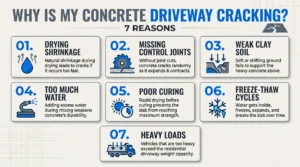
Why Is My Concrete Driveway Cracking? 7 Reasons
1. Normal Drying Shrinkage
Concrete shrinks as extra mixing water evaporates. Journal of Light Construction, in an answer from a Portland Cement Association representative, calls this shrinkage and load cracking explained and describes drying shrinkage as an inherent property of concrete. The slab is held back by the ground beneath it, so it cracks as it pulls tight.
- What it looks like: thin cracks that appeared in the first months or year
- Fix: seal narrow cracks with a flexible filler so water stays out, and keep an eye on them
2. Missing or Misplaced Control Joints
Control joints are planned weak lines that tell a slab where to crack. The NRMCA lists missing or poorly done joints as a leading cause of cracking. JLC says joints should be cut to about a quarter of the slab thickness and spaced no more than 30 times the thickness apart, which is roughly 10 feet for a four inch slab. It also says driveways wider than 10 feet need joints in both directions.
- What it looks like: random cracks that wander instead of following a straight joint line
- Fix: a contractor may be able to add relief cuts, but widespread random cracking often means the layout was off from the start
3. Weak or Settling Soil Under the Slab
This is the cause we see most in our area. Williamson and Maury County sit on clay that swells when wet and shrinks when dry, and many newer lots sit on fill soil that has not fully settled. When the ground moves, voids open under the slab and panels tip or sink. The NRMCA says topsoil and soft spots should be removed and the base compacted and sloped for drainage.
- What it looks like: sunken corners, gaps at the garage apron, rocking panels, or cracks with one side higher
- Fix: stabilize or level a slab that is still in good shape, or replace it with a properly compacted gravel base
4. Too Much Water or Poor Finishing
Adding water at the job site makes concrete easier to place but weaker and more likely to crack. The NRMCA warns against high slump mixes, extra water, and overworking the surface. JLC adds that once the mix is ordered to a set slump, crews should not add more water to speed the pour.
- What it looks like: map cracking, crazing, or a flaky surface soon after the pour
- Fix: prevention is the best answer, and existing surface damage can often be sealed or repaired if the slab is sound underneath
5. Poor Curing
Curing means keeping fresh concrete from drying out too fast. The NRMCA recommends curing compound or damp burlap for at least three days, while JLC mentions five to seven days. Cool weather changes the schedule too, which is covered in our post on pouring a concrete driveway in October.
- What it looks like: early cracking and a dusty or weak surface
- Fix: proper curing at install, since it cannot be repeated later
6. Freeze Thaw Cycles and Deicing Salt
Middle Tennessee winters bring repeated freezing and thawing, and that is hard on any driveway. The Federal Highway Administration explains that concrete frozen while saturated can suffer freeze thaw damage in concrete, and that chemical deicers can make it worse. The Tennessee Concrete Association driveway guidance adds that most Tennessee driveways fall in a very severe freeze thaw exposure class, so it tells homeowners not to apply salt or deicers during the first winter.
- What it looks like: flaking, scaling, and cracks near joints and edges
- Fix: use clean sand for traction, limit salt, and apply a penetrating sealer after curing
7. Heavy Loads and a Thin Slab
JLC says a slab cracks from applied loads when weight stresses it beyond its strength, and recommends 5 to 6 inches for driveways expecting heavy truck traffic, with 4 inches adequate otherwise. Concrete trucks, dumpsters, and delivery vehicles can overload a thin driveway. The Tennessee Concrete Association notes a minimum thickness of three and a half inches under the ACI residential code, so thickness matters.
- What it looks like: cracks near edges and wheel paths, or broken corners
- Fix: keep heavy vehicles off, and plan a thicker replacement slab if the damage keeps spreading
Repair or Replace? Key Differences
Once you have an answer to why is my concrete driveway cracking, the next question is cost and effort. Our guide on how to repair or replace a concrete driveway goes deeper, but here is the short version.
- Repair fits limited cracks on a sound slab where the base is stable
- Leveling fits slabs that sank but are still mostly in one piece
- Replacement fits cracks across many panels, a crumbling surface, rocking slabs, or a driveway that was poured thin or on dirt
- If the same crack reopens every wet season, the soil or drainage is still the problem
Stamped concrete driveways follow the same rules, since a stamped surface is still a concrete slab that depends on the base, joints, and curing underneath.
How a New Driveway Is Built to Resist Cracking
Most cracking problems trace back to what happened before and during the pour. Our concrete driveway installation process is built around fixing those causes:
- Full excavation and a compacted gravel base, never concrete poured directly on dirt
- Fiber reinforced concrete, with rebar on structural sections
- Slope and drainage planned so water moves away from the slab and the house
- Joints laid out at the right depth and spacing
- Proper curing and clear instructions for first winter care
Homeowners in Maury County can see how this applies to older properties on our page for concrete driveway replacement in Columbia, and you can browse our completed driveway projects to see finished work.
Simple Habits That Prevent More Cracks
- Seal narrow cracks and apply a penetrating sealer after the concrete has cured
- Keep gutters and downspouts pointed away from the driveway edges
- Skip salt the first winter and use sand for traction
- Keep heavy trucks and equipment off thin or older slabs
- Watch cracks after heavy rain and note any that widen or sink
Frequently Asked Questions
Q: Why is my concrete driveway cracking if the cracks are only hairline thin?
A: Often yes. Concrete shrinks as it dries, so thin hairline cracks can form without harming the slab. Watch for cracks that widen, sink, or leave one side higher than the other, since those point to deeper problems.
Q: Can I fill a cracked concrete driveway myself?
A: You can seal narrow cracks with a flexible concrete crack filler to keep water out of the slab. Wide cracks, uneven panels, or cracks that keep coming back mean the base or drainage needs a professional look.
Q: How do I know if a cracked driveway needs repair or replacement?
A: Repair fits limited cracks on a sound slab with a stable base. Replacement fits cracks across many panels, a crumbling surface, rocking slabs, or repeat failures. A site visit checks soil and drainage first.
Q: Does salt make a concrete driveway crack?
A: Deicing salts can cause scaling and surface damage, especially on new concrete, and they make freeze thaw damage worse over time. Skip salt the first winter and use clean sand for traction on the surface instead.
Q: Why do some Middle Tennessee driveways crack faster than others?
A: Clay soil swells and shrinks with moisture, and some new lots sit on fill that has not settled. A compacted gravel base, proper joints, and drainage away from the slab help limit slab movement over time.
Final Thoughts
So, why is my concrete driveway cracking? Usually it comes down to shrinkage, missing joints, weak soil, too much water, poor curing, freezing thaw weather, or heavy loads, and often more than one at once. The good news is that a cracked driveway is easier to fix once the cause is clear, and a short inspection can tell you whether sealing, leveling, or replacement makes sense. Cracks are only one warning sign, so see all 7 signs your concrete needs repair.For a straight answer on your slab, call AMC Concrete at 931-416-5131 or request a free estimate today. AMC Concrete operates under contractor license #82787.