The first freeze arrives, and you stand in the garage holding a bag of rock salt. Before you spread it, you probably wonder what salt is safe for concrete driveway surfaces. Middle Tennessee homeowners ask this question every winter, and they have good reason to worry. The wrong deicer can leave a driveway flaking, pitted, and cracked by spring.
This guide gives you a clear answer based on more than 20 years of pouring and repairing concrete in Columbia, Franklin, and Spring Hill. You will learn which products protect your slab, which ones harm it, and when to skip deicer entirely.
Key Takeaways
- No deicer is completely harmless, but sand, calcium magnesium acetate (CMA), and potassium acetate cause the least damage.
- Concrete poured within the last year needs no chemical deicers at all.
- Ammonium nitrate and ammonium sulfate attack concrete chemically, so avoid them.
- A penetrating sealer applied in fall gives your driveway the best protection.
What Salt Is Safe for Concrete Driveway Slabs? The Short Answer
Sand is the safest option because it adds traction without any chemistry. However, sand does not melt ice. If you need melting power, choose CMA or potassium acetate. Both products treat concrete gently, although they cost more than rock salt.
Calcium chloride and magnesium chloride sit in the middle. They melt ice fast and work at very low temperatures. Nevertheless, heavy applications can chemically stress the concrete paste, so use them in small amounts and only on mature, sealed slabs.
Rock salt (sodium chloride) is the cheapest and most common choice. It does not attack concrete as aggressively as some other chemicals. Still, it worsens freeze-thaw damage, which makes it risky for young, unsealed, or already cracked driveways.
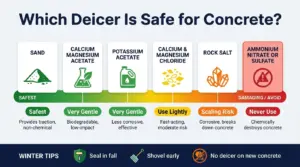
How Common Deicers Compare
| Deicer | Concrete Safety | Works Down To (approx.) | Best Use |
|---|---|---|---|
| Sand or grit | Safest | Not applicable (traction only) | New or damaged concrete |
| Calcium magnesium acetate | Very gentle | 20°F | Sealed, mature concrete |
| Potassium acetate | Very gentle | -15°F | Sealed, mature concrete |
| Magnesium chloride | Moderate risk | 5°F | Light use on sound concrete |
| Calcium chloride | Moderate risk | -25°F | Light use on sound concrete |
| Rock salt (sodium chloride) | Higher scaling risk | 15°F | Occasional use on sound concrete |
| Ammonium nitrate or sulfate | Damaging | Varies | Never use on concrete |
Temperatures vary by product concentration, so always read the label before you buy.
Why Tennessee Winters Challenge Concrete
Middle Tennessee rarely stays frozen for months. Instead, temperatures swing above and below 32°F again and again, and that pattern punishes concrete more than steady cold does. Water seeps into tiny pores in the slab, freezes, and expands by roughly nine percent. Then the ice thaws, and the cycle starts over.
Our local soil adds to the problem. Expansive clay swells when wet and shrinks when dry, so it shifts the base under your slab. When a driveway sits on a poorly prepared base, freeze-thaw stress finds weak spots quickly.
Deicers complicate this further. They melt ice, but they also pull moisture into the surface, so the concrete stays wetter for longer. As a result, each freeze-thaw cycle does more harm. Over one winter, that stress shows up as scaling, which means thin layers of the surface peel away and expose the rough aggregate underneath.
If you already see cracks after a cold season, read our guide on concrete driveway cracks after winter in TN to learn what causes them.
What to Avoid on Your Driveway
Some products and habits cause far more harm than others. Keep these off your slab:
- Ammonium nitrate and ammonium sulfate: Industry groups such as the American Concrete Institute warn that these chemicals break concrete down from the inside. Some fertilizer-style ice melts contain them, so check every label.
- Heavy, repeated rock salt use: Piling on extra product does not melt ice faster. It simply adds more chemical to the surface.
- Metal shovels and blades: These tools scrape and chip edges and joints, which opens new paths for water.
- Deicer on unsealed, damaged concrete: Cracks and pits absorb salty water quickly, so damage spreads fast.
New Concrete Needs Extra Care
Homeowners who ask what salt is safe for concrete driveway projects under one year old need a different answer: none. Fresh concrete keeps gaining strength and density for months. During that time, it resists scaling poorly, even if it looks perfect.
Follow these steps during the first winter:
- Skip every chemical deicer.
- Spread sand for traction instead.
- Shovel snow early, before foot and vehicle traffic packs it into ice.
- Ask your contractor about the mix design, because strength and reinforcement both affect how well the slab handles freezing.
On every pour, our crew uses a 3,500 PSI minimum mix with Fibermix fiber reinforcement, and we set the slab on a compacted gravel base. That foundation helps a new driveway survive its first winter, but it does not replace careful winter habits.
How to Protect Your Driveway Before Winter
Preparation matters more than any product you buy. We recommend this routine every fall:
- Seal the surface. A quality penetrating sealer blocks water and salt from soaking in. Apply it before the first freeze, and reapply it every two to three years, depending on traffic and wear.
- Fill small cracks. Water in a hairline crack becomes a wide crack after only a few freezes.
- Check drainage. Pooled water creates ice patches and speeds up damage, so redirect downspouts away from the slab.
- Shovel promptly. Less ice means you need less deicer.
- Apply deicer lightly. A thin, even layer works as well as a thick one.
- Rinse in spring. Wash leftover salt residue away once the weather warms.
Signs Your Driveway Already Has Damage
Winter often reveals problems that were quietly developing. Watch for flaking or peeling surfaces, small pits, widening cracks, and slabs that sink or sit unevenly. Each sign tells you something different about the slab’s condition. Our list of the top 7 signs your concrete needs repair before it’s too late helps you decide whether you face a quick fix or a larger project.
When Repair or Replacement Makes Sense
Sealing and patching can extend the life of a driveway in decent shape. On the other hand, a badly scaled, heavily cracked, or sinking driveway costs more to repair again and again than to replace once. A properly prepared, reinforced, and sealed driveway handles Tennessee winters far better.
Planning a replacement? Our concrete driveway installation service covers excavation, base preparation, reinforcement, and finishing, and every project carries a 3-year written workmanship warranty. Right now, we also include a free patio with every new driveway. That offer lets you upgrade your entire outdoor space in one project, and you can browse our concrete patio designs or our stamped concrete options for ideas.
Budget questions come up early in most projects. Our guide to concrete cost per yard in Columbia, TN and our concrete calculator help you plan before you call.
Why Homeowners Trust AMC Concrete
Adam Mills founded AMC Concrete as a veteran-owned company based in Columbia, Tennessee. Over the years, our team has completed more than 100 projects across Maury and Williamson Counties. We hold Tennessee contractor license #82787, carry full insurance, and maintain a BBB accredited business profile.
We see the results of both good and poor winter care every spring, so our advice comes from real driveways, not guesswork. You can review our completed projects in the gallery or read what neighbors say on our testimonials page.
We serve homeowners in Columbia, Spring Hill, Franklin, and Brentwood, with driveway replacement pages for each area.
Frequently Asked Questions
What salt is safe for concrete driveway use in Tennessee winters?
Calcium magnesium acetate and potassium acetate rank among the gentlest options, and sand is the safest for traction. Use any chloride-based product lightly, and only on mature, sealed concrete.
Is rock salt bad for concrete driveways?
Rock salt can damage young, unsealed, or cracked concrete because it increases freeze-thaw stress and causes scaling. On mature, sealed concrete, occasional light use carries a lower risk.
Can I use deicer on a new driveway?
No. Avoid every chemical deicer during the first full winter after the pour, and use sand instead.
Does sealing a driveway really help?
Yes. A penetrating sealer reduces water and salt absorption, which cuts down on scaling and cracking.
When should I seal my concrete driveway?
Seal it in fall, after the concrete has fully cured and before the first freeze.
Ready to Protect or Replace Your Driveway?
Whether you need a sealing recommendation, a crack repair, or a brand-new slab, our team will give you honest advice. Request a free estimate or call (931) 416-5131 today, before the next freeze arrives.