You walk past your retaining wall after a cold snap and spot a new crack. Maybe the wall also seems to lean a little more than it did last spring. Naturally, you want to know why concrete retaining wall cracks appear, and whether the wall is about to fail. Some cracks are harmless, while others warn of serious pressure behind the wall.
This guide explains the common causes, shows you how to read different crack patterns, and tells you when to call a professional. It comes from more than 20 years of pouring and repairing concrete across Middle Tennessee.
Key Takeaways
- Water trapped behind the wall causes most serious damage, so drainage matters more than almost anything else.
- Thin vertical hairline cracks are often cosmetic, but horizontal cracks and leaning are not.
- Tennessee’s clay soil and repeated freeze-thaw cycles add stress every winter.
- Do not ignore a crack that widens, a wall that tilts, or soil that bulges.
- Many repairs work only if you fix the cause, not just the crack.
Why Concrete Retaining Wall Cracks: The Short Answer
A retaining wall holds back soil, and that soil pushes against the wall every day. Water makes the push much stronger. When rain soaks the soil and the water has nowhere to go, pressure builds behind the wall. Then winter arrives, the trapped water freezes and expands, and the wall takes even more force.
Cracks appear when that pressure exceeds what the wall can resist. Weak footings, missing reinforcement, poor soil, and clogged drainage all lower the wall’s resistance. As a result, a small design or installation flaw can show up as a crack years later.
What Winter Does to a Retaining Wall
Middle Tennessee swings above and below 32°F many times each winter. Water inside the soil and inside the concrete freezes, expands by roughly nine percent, and thaws again. Each cycle pushes against the wall and widens tiny gaps.
Retaining wall cracks in winter often follow a pattern. A wall that held steady through summer suddenly shows new cracks after a few freeze-thaw cycles. Frozen soil can also swell and press on the wall, a force engineers call frost heave. Therefore, the coldest weeks often reveal problems that were quietly developing in warmer months.
Our local soil makes things harder. Expansive clay swells when wet and shrinks when dry, so it keeps shifting the load on the wall. For a broader look at how freezing weather damages slabs, read our guide on concrete cracks in winter.
Retaining Wall Drainage Problems
Drainage deserves its own section because it causes more failures than any other factor. Soil holds a lot of weight when dry. Saturated soil weighs more and pushes harder, and that extra force is called hydrostatic pressure.
A well-built wall relieves this pressure with several parts:
- Gravel backfill behind the wall lets water move down instead of building up.
- A perforated drain pipe at the base carries water away from the wall.
- Weep holes in the face release water through the wall.
- Surface grading sends rain away from the wall, not toward it.
Drainage problems show up in recognizable ways. Look for wet stains or white mineral streaks (called efflorescence) on the wall face, water pooling at the base, soil washing out at the ends, or weep holes that stay dry during rain. Any of these signs means water has no clear exit. Likewise, downspouts that empty right above the wall can overload even a well-built system.
Common Causes of Cracks
Beyond drainage, several other issues contribute:
- Weak or shallow footing. A wall needs a solid base below the frost line. If the footing sits too shallow or on poorly compacted soil, the wall shifts and cracks.
- Missing reinforcement. Rebar helps concrete resist the bending force of soil. Walls built without enough steel crack more easily.
- No control joints. Concrete shrinks as it cures, and control joints guide where it cracks. Without them, cracks form in random places.
- Extra weight above the wall. A driveway, a parked truck, a shed, or a new patio on the high side adds pressure the wall may not handle.
- Tree roots. Roots push against the wall and pull moisture from the soil, which causes uneven settling.
- Age and wear. Even a good wall loses strength to repeated freezing and thawing over decades.
Sometimes several causes work together. That overlap explains why a wall with only a small drainage flaw can still crack badly after a hard winter.
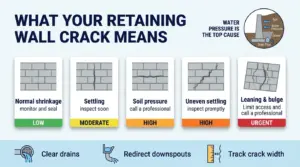
What Your Crack Is Telling You
Not every crack carries the same warning. Use this table as a rough guide, and remember that a professional inspection gives the real answer.
| Crack or Sign | What It Often Means | Urgency |
|---|---|---|
| Thin vertical hairline crack | Normal shrinkage or minor settling | Low: monitor and seal |
| Vertical crack that widens over time | Differential settling or footing movement | Moderate: inspect soon |
| Horizontal crack | Soil pressure pushing the wall outward | High: call a professional |
| Diagonal or stair-step crack | Uneven settling or foundation movement | High: inspect promptly |
| Wall tilting or retaining wall leaning | Overloaded wall or failing base | Urgent: limit access and call a professional |
| Bulging face or soil washing out | Severe water pressure or drainage failure | Urgent: call a professional |
A quick test helps you track change. Mark each end of a crack with a pencil, measure its width, and photograph it with a ruler beside it. Check again after rain and after each freeze. If the crack grows, the wall is still moving.
When a Leaning Wall Is an Emergency
Leaning is different from cracking. Cracks show stress, but a lean shows movement. If your retaining wall leans or bulges, keep children, pets, and vehicles away from the area. Do not park or build anything near the high side until someone inspects it.
Tall walls carry greater risk. Many local codes require engineering and permits for walls above a certain height, often around four feet, though rules vary by city and county. Check with your local building office before you start any major repair. Meanwhile, avoid digging near the base of a leaning wall.
What You Can Do Right Now
Several steps cost little and slow the damage:
- Clear drains and weep holes. Remove leaves, mud, and debris so water can exit.
- Redirect runoff. Extend downspouts and regrade low spots so rain flows away from the wall.
- Seal hairline cracks. Use a flexible exterior crack filler to keep water out of small gaps.
- Reduce load. Move heavy items away from the top of the wall.
- Avoid harsh deicers nearby. Salt-laden meltwater can attack concrete, so read our guide on what salt is safe for your concrete driveway before winter.
- Document changes. Photos and measurements help a contractor judge how fast the wall is moving.
Repair or Rebuild?
The right fix depends on the cause. Minor cracks with good drainage often need only sealing and better water control. In contrast, a leaning wall, horizontal cracking, or a failed footing usually calls for deeper work, such as rebuilding the wall with proper drainage, reinforcement, and a stable base.
Patching alone rarely works when the cause remains. A crack filled over a clogged drain simply returns. Therefore, a good contractor looks at the soil, water flow, and footing first, then recommends the repair that actually solves the problem.
Our concrete retaining wall service covers inspection, repair, and full rebuilds across Middle Tennessee. If you also see cracks in your driveway, our guide to concrete driveway cracking causes and fixes helps you tell the difference between surface cracks and deeper movement. For a broader view, our concrete foundation page explains how a strong base prevents these problems.
Why Homeowners Trust AMC Concrete
Adam Mills founded AMC Concrete as a veteran-owned company based in Columbia, Tennessee. Our team has completed more than 100 projects across Maury and Williamson Counties. We hold Tennessee contractor license #82787, carry full insurance, and maintain a BBB accredited business profile.
Every pour uses a 3,500 PSI minimum mix with Fibermix fiber reinforcement over a compacted gravel base, and every project carries a 3-year written workmanship warranty. You can review our work in the project gallery or read what neighbors say on our testimonials page.
Frequently Asked Questions
Why concrete retaining wall cracks form in winter?
Trapped water freezes, expands, and presses on the wall, while frozen soil adds extra force. Repeated freeze-thaw cycles then widen small cracks into larger ones.
Are hairline cracks in a retaining wall serious?
Thin vertical hairline cracks are often cosmetic, caused by normal shrinkage. Measure them over time, and call a professional if they widen or turn horizontal.
What causes a retaining wall to lean?
Leaning usually comes from water pressure, a weak footing, overloaded soil, or poor drainage. Treat any lean as urgent and have a professional inspect the wall.
Can I repair retaining wall cracks myself?
You can seal small, stable hairline cracks with flexible filler. However, widening, horizontal, or leaning problems need professional diagnosis, because filling them does not fix the cause.
How much does concrete retaining wall repair in Tennessee cost?
Cost depends on wall height, length, access, and the cause of damage. A free on-site inspection gives you a realistic quote.
Get Your Retaining Wall Checked
Not sure whether your crack is cosmetic or serious? Let our team look at it before the next freeze. We inspect the wall, check drainage, and give you honest advice on repair or rebuild options. Request a free estimate or call (931) 416-5131 to schedule your visit.