Why does concrete crack in winter, even when the slab looks perfect in the fall? The answer is water. Concrete is porous, so it absorbs moisture, and when temperatures swing above and below 32 degrees, that moisture freezes and thaws again and again. Engineers call this freeze-thaw deterioration in concrete, and it can cause scaling, spalling and cracks. Tennessee property owners see it every year because our winters bounce between frosty nights and mild afternoons.
That repeated cycle explains why slabs fail in so many different ways here. Rain, snowmelt and poor drainage keep the surface damp, while clay soil under the slab swells and shifts. Both problems feed into concrete foundation problems as well as driveway, patio and walkway damage. This guide explains what is happening inside your concrete, how to spot trouble early, and what you can do about it.
How Water Causes Concrete to Crack
Concrete looks solid, but it is full of tiny pores and capillaries. Rain, melting snow and groundwater soak into them. To understand how freeze-thaw damage affects concrete, think about what ice does. Ice takes up more space than liquid water, so freezing water inside the pores pushes outward. Damage begins when that pressure is greater than the strength of the surrounding concrete.
Key points to remember:
- Water expands by about 9 percent when it turns to ice.
- A soaked slab is at far greater risk than a dry one.
- Every freeze and thaw cycle adds a little more damage.
- Deicing chemicals can make surface damage worse.
- Edges, joints and low spots crack first because moisture collects there.
Why Does Concrete Crack in Winter Across Tennessee?
Many people assume freeze-thaw damage only happens in northern states. Federal highway research says otherwise, noting that these problems are not limited to the far north. Tennessee has plenty of nights that dip below freezing followed by days that warm up, which is the exact pattern that stresses concrete.
Local conditions add to the problem:
- Expanding clay soil: Clay swells when wet and shrinks when dry, which moves the slab above it.
- Fast growth and fill soil: New neighborhoods often sit on soil that has not fully settled.
- Poor drainage: Downspouts, grading and irrigation that send water toward a slab keep it saturated.
- Thin or poorly prepared bases: Concrete poured on weak support cracks sooner under winter stress.
Signs of Winter Concrete Damage
Catching damage early keeps a small repair from becoming a replacement. Walk your property after the first hard freeze and look for these warning signs:
- Fine web-like cracks across the surface
- Flaking or peeling, known as scaling
- Small chips or craters, called pop-outs
- Edges or joints that crumble
- Cracks that get wider from one month to the next
- Sunken, lifted or uneven sections
- Water that pools instead of draining away
Walkways often show problems first because they are thinner and see heavy salt use. If you notice flaking or trip hazards, read about concrete sidewalk cracks and repairs before the next freeze makes them worse.
Difference Between Shrinkage Cracks and Freeze-Thaw Cracks
Not every crack comes from winter. Knowing the difference helps you decide what to do, and it answers why concrete cracks in winter on your own property when the slab is only a few years old.
Shrinkage cracks
- Appear within the first weeks or months after the pour
- Usually thin and fairly straight
- Often follow control joints
- Rarely cause flaking or crumbling
Freeze-thaw cracks
- Appear after one or more winters
- Often look like a web or map pattern
- Come with scaling, chipping or spalling
- Keep widening and spreading over time
Common Winter Damage at a Glance
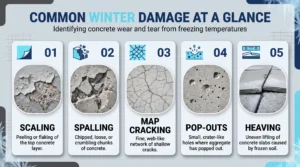
| Type of Damage | What You See | Likely Cause | Typical Fix |
| Scaling | Flaking, peeling surface | Water and deicers on weak surface | Resurface or replace section |
| Spalling | Chunks breaking away | Deep freezing and moisture buildup | Patch or remove and repave |
| Map cracking | Fine web of cracks | Repeated freeze-thaw cycles | Seal and monitor, or resurface |
| Pop-outs | Small craters | Saturated aggregate near surface | Fill and seal |
| Heaving or settling | Raised or sunken slab | Frozen or shifting soil beneath | Correct base, replace slab |
Concrete Installation and Durability
Most winter damage starts on the day of the pour. A durable slab depends on soil preparation, a compacted base, the right thickness, a strong mix, proper jointing, drainage and careful curing. Skipping any one of these steps invites trouble later. If you are planning a new project, understanding concrete slab installation and costs helps you compare bids fairly and avoid shortcuts that look cheap today and cost more after two winters.
At AMC Concrete, every pour uses a 3,500 PSI minimum mix with fiber reinforcement, a compacted gravel base and a vapor barrier. Structural slabs and garage floors also receive rebar. Our veteran-owned team has served Tennessee homeowners and businesses for over 20 years, and every project includes a 3-year written workmanship warranty.
How to Prevent Concrete Cracks in Winter
You cannot stop the weather, but you can limit how much water your concrete holds and how hard it works. Industry guidance on cold-weather concrete protection recommends air-entrained mixes with a low water to cement ratio, proper curing, avoiding late season pours and keeping deicers off new surfaces during the first season.
Practical steps for property owners:
- Fix drainage so water runs away from slabs.
- The seal cracks early so water cannot get in.
- Apply a quality concrete sealer once the slab has fully cured.
- Shovel snow promptly instead of letting it melt and refreeze.
- Use sand for traction instead of rock salt, especially on new concrete.
- Clear gutters and extend downspouts.
- Ask your contractor about air-entrained concrete for exterior work.
If your driveway has crumbled past the point of repair, quality concrete driveway installation with the right base, reinforcement and drainage is the long-term answer.
Preventing Freeze-Thaw Damage on Patios
Outdoor living areas collect water, so they need the same planning. A properly graded surface, solid base and sealed finish protect decorative work from freezing moisture. Homeowners who want a patio that looks great and holds up through Tennessee winters can explore stamped concrete patio installation built with these protections in mind.
The best answer to why concrete cracks in winter is that water gets in and freezes. Keep it out, and your concrete lasts longer.
Repair or Replace? How to Decide
Repair may work when:
- Cracks are thin and stable
- Damage is limited to the surface
- The slab is level and drains properly
Replacement is usually smarter when:
- Large areas are flaking or crumbling
- Cracks keep widening
- The slab has sunk or lifted
- Repeated patching is no longer holding
A professional inspection tells you which path makes sense before you spend money on the wrong fix.
Frequently Asked Questions
Q: Why does concrete crack in winter even when temperatures only dip below freezing at night?
A: Water in the slab freezes, expands and pushes against the concrete from inside. Tennessee nights often dip below freezing and warm up by day, so the slab freezes and thaws over and over until cracks form.
Q: Is it safe to put rock salt on a concrete driveway in winter?
A: Rock salt can speed up scaling and surface damage, especially on newer concrete. Use sand for traction instead, and shovel snow early. Ask your contractor before using any deicer on a slab poured this year.
Q: Should I repair a cracked slab or replace it?
A: Hairline cracks that stay tight can often be sealed. Wide, uneven or crumbling areas usually mean deeper damage, so replacement may last longer. A local contractor can inspect the slab and explain both options.
Q: What is the difference between shrinkage cracks and freeze-thaw cracks?
A: Shrinkage cracks show up early, often within weeks, and stay thin and straight. Freeze-thaw damage appears after winters of repeated freezing and often brings flaking, rough patches or cracks that keep widening.
Q: Does AMC Concrete repair or replace winter damaged slabs in Tennessee?
A: AMC Concrete handles concrete repair and replacement for driveways, patios, sidewalks and slabs in Columbia, Franklin and across Middle Tennessee. Call 931-416-5131 to describe the damage and ask for a free estimate.
Final Thoughts
Winter cracking is not random. Water enters the pores of your concrete, freezes, expands and repeats the cycle until the surface gives way. Good drainage, a strong mix, proper curing and smart deicing habits go a long way toward keeping your driveway, patio, sidewalk and foundation in good shape.
If you already see cracks, flaking or sunken sections, do not wait for another freeze to make them worse. AMC Concrete is a licensed Tennessee contractor (License number 82787), insured and BBB accredited. You can request a free concrete estimate online, or call us directly at 931-416-5131.