Why is my concrete turning white? It is one of the most common questions we hear from Middle Tennessee homeowners, and the answer is not always the same. A white film on a driveway, patio, or garage floor can be harmless mineral salt, a cloudy sealer, or the first sign of surface damage. AMC Concrete has poured and repaired slabs across the region for years, and our team offering concrete services in Columbia, TN sees all three every season.
Knowing which one you have saves money, because each needs a different fix. A cloudy patio, for example, may point to a sealing problem rather than a concrete problem, and our guide on how often to seal concrete patio surfaces explains why timing and product choice matter.
Key Points at a Glance
- A white powder that brushes off is often efflorescence, which is salt left behind by moving water.
- A cloudy or milky film under a coating is often sealer haze, not damage.
- Flaking or peeling surface layers point to scaling, and deicing salt makes it worse.
- Moisture under or around the slab is the root cause in many cases.
- Cleaning only works long term when you also fix the water source.
Why Is My Concrete Turning White? Start With the Clues
Before you scrub anything, look closely. The pattern tells you a lot. Ask yourself:
- Where is it? White marks near edges, joints, and low spots point to water movement.
- When did it start? After rain, after a cold snap, or soon after a new pour?
- What does it feel like? Powder, a smooth film, or rough flakes each mean something different.
- Is the slab sealed? A cloudy coat suggests a sealer issue.
- Has deicing salt touched it? Salt can cause both staining and surface flaking.
Take a few photos in daylight. They help you track changes and give a contractor useful information later.
What Causes Efflorescence
To understand what causes efflorescence, think of concrete as a hard sponge. Water moves through tiny channels inside it, carries soluble salts and other minerals to the surface, and leaves them behind as it dries. QUIKRETE explains that cold temperatures, damp conditions, rain, dew, condensation, and too much water in the original mix all make this more likely.
Any material made with portland cement can show efflorescence. The salts can come from the cement, the sand and gravel, the mixing water, or additives. It can appear within weeks of a pour or show up years later when moisture patterns change.
Common triggers in Tennessee include:
- Spring rains that soak slabs with poor drainage
- Downspouts that dump water beside a patio or driveway
- Soil that stays wet against a slab edge
- Hard water from sprinklers hitting the surface
- A mix that held extra water when it was placed
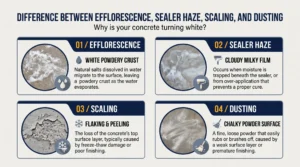
Difference Between Efflorescence, Sealer Haze, Scaling, and Dusting
When homeowners ask why is my concrete turning white, they often mix up four different problems. The table below shows how to separate them.
| Problem | What It Looks Like | Common Cause | Usual Fix |
| Efflorescence | Dry white powder or crust that may brush off | Salts carried to the surface by moisture | Dry brushing or an efflorescence cleaner, then fix the water source |
| Sealer haze | Cloudy or milky film with a patchy shine | Moisture trapped under sealer, a thick coat, or sealing a damp slab | Follow the sealer maker’s removal steps, then recoat thinly |
| Scaling | Flaking, peeling, or pitted top layer | Freeze thaw cycles, deicing salt, or a weak surface | Repair or resurface, sometimes replace |
| Dusting | Fine chalky powder that returns after sweeping | A weak surface from overworking or poor curing | Surface hardener or sealer, or a new surface if severe |
The first two are mostly cosmetic. The last two are surface weaknesses, and they tend to get worse if ignored.
Deicing Salt and Scaling
Middle Tennessee winters swing above and below freezing, and repeated freeze-thaw damage in winter is a leading reason surfaces start to flake. Add deicing salt and the problem speeds up.
A presentation shared by UConn engineers on surface scaling and deicing salt lists common causes such as low air content in the mix, an overworked surface, poor curing, early exposure, and deicing salt. It also notes that young concrete is especially vulnerable. Its advice is to skip deicers during the first winter if you can, wait at least two to three months if you cannot, and protect the surface with a silane or siloxane sealer.
The Federal Highway Administration backs up the risk. Its research on freeze thaw damage in concrete pavement says deicing chemicals can amplify freeze thaw deterioration.
To protect your slab this winter:
- Shovel snow early instead of relying on salt
- Use sand for traction on new concrete
- Rinse salt off the surface when temperatures rise
- Keep standing water from freezing on the slab
Sealer Haze: When a Sealer Turns Concrete White
If you are still asking why is my concrete turning white right after sealing, the sealer is the likely suspect. Film forming sealers can turn cloudy when moisture is trapped underneath, when the coat goes on too thick, or when the slab was damp during application. Concrete needs to release moisture, and a coating that blocks it can turn milky.
If you see haze:
- Do not scrub hard or pressure wash at high settings
- Read the sealer label for the maker’s removal or recoat steps
- Test any remover on a small hidden spot first
- Reseal in thin, even coats on a dry slab in suitable weather
Built Right From the Start
Good preparation prevents many of these problems. A compacted gravel base, a vapor barrier, a properly mixed and cured slab, and smart drainage all reduce the moisture that causes white stains. You can see how our crews finish slabs in our completed concrete projects.
Moisture Under the Slab, in Basements, and in Garages
Sometimes the white film is a symptom of water coming up from below. The EPA explains that water can enter a home by seeping through basement floors, and its guidance on how to control moisture in your home also recommends sloping the ground away from the house and using gutters to move water off the property.
For basement and garage slabs, check:
- Gutters and downspouts that discharge near the foundation
- Soil that slopes toward the building
- Plumbing leaks near the slab
- Missing or damaged vapor barriers under older slabs
Avoid sealing or coating a slab that is still damp. That traps moisture and can create haze, bubbling, or peeling.
How to Fix White Concrete
Match the fix to the cause:
- Efflorescence: Sweep off dry powder, then use a cleaner made for efflorescence. Wear gloves and eye protection, test a small spot, and rinse well. QUIKRETE warns that sandblasting can etch and weaken the surface, so skip it.
- Sealer haze: Follow the sealer maker’s instructions for removal, then recoat thinly.
- Hard water spots: Rinse the area and adjust sprinklers so they miss the slab.
- Scaling or dusting: Cleaning will not help. The surface needs repair, resurfacing, or replacement.
If the stain returns within weeks, water is still moving through the slab. Fix the source before you clean again.
When a White Stain Becomes Real Damage
Call a professional when you see crumbling, deep pitting, loose flakes, or cracks that keep growing. NRMCA publishes concrete cracking and scaling resources that show how these surface defects start and why they matter. If cracks are part of your problem, read about the other causes of driveway cracks.
For larger problems, the decision usually comes down to cost and condition. Our guide on how to repair or replace a concrete driveway walks through the signs that a slab has reached the end of its life.
Warning signs include:
- Flaking across large areas
- Soft or sandy surface that rubs off
- Cracks wider than a hairline
- Water pooling on the slab
- Stains that return after cleaning
Frequently Asked Questions
Q: Why is my concrete turning white after rain?
A: Rain can carry moisture through the slab and bring salts to the surface. When the water dries, a white powder stays behind. This is usually efflorescence, and it often returns until the moisture source is fixed.
Q: Can I remove white stains on concrete myself?
A: Often yes. Sweep dry powder, then use a cleaner made for efflorescence and test a small spot first. Wear gloves and eye protection, and rinse well. Skip sandblasting, since it can etch and weaken the surface.
Q: How can I tell efflorescence from scaling?
A: Efflorescence is a white powder that sits on the surface. Scaling is flaking, where the top layer peels or chips away and leaves rough spots. Powder points to salts, while flaking points to freeze thaw damage.
Q: When should I call a contractor about white marks on concrete?
A: Call a pro when the surface flakes or crumbles, or when white marks return after cleaning. A contractor can check drainage, sealer problems, and the base under the slab before you spend money on repairs.
Q: How can I keep white stains from coming back?
A: Keep water away from the slab with good drainage and gutters. Seal the surface with a breathable sealer, rinse off deicing salt, and avoid salting new concrete during its first winter. Check the slab each season.
Final Thoughts
Asking why is my concrete turning white is the right first step, because the cause decides the fix. Powder usually points to moisture and salt, a cloudy film points to the sealer, and flaking points to surface damage. Fix the water first, clean carefully, and protect the slab before winter.
Not sure what you are looking at? Get a free inspection or call AMC Concrete at 931-416-5131. We are a veteran owned team serving Columbia and the surrounding area, and our contractor license number is 82787.